- Visit
- Things to Do
- Learn
- Arboretum
- Research
- Support
- About
Students Reengage with Math in Nature

From Equations to Ecosystems: Students Reengaging with Math in Nature
By Harrison Jackson, Director of preK-12 Education
If functions frustrate you, proofs perplex you, or variables leave you scratching your head then you’re not alone. As students dive into Algebra, Advanced Geometry, Calculus, and beyond, concepts that once felt clear and logical can suddenly seem unfamiliar and overwhelming. But here at Blandy we believe that math is intuitive in nature and sometimes all it takes to create that spark of understanding is to get your hands dirty.
Earlier this fall, over 90 Frederick and Fauquier County high schoolers in the Algebra, Functions and Data Analysis (AFDA) and similar classes came to Blandy for an immersive field investigation. The students collected, analyzed and graphed authentic, real-world data on how plant diversity and soil pH vary across fields that are under different maintenance regimes.
 Using tools like soil pH meters, students worked in teams to collect samples and record field observations. They measured soil pH and moisture, estimated plant coverage, and documented species diversity within their quadrat as they sampled across a transect. As students collected samples they used critical thinking and problem-solving skills to keep data collection consistent as their soil and plant communities changed the further afield they went.
Once they had finished collecting data outdoors, the focus shifted to indoor data analysis. Students and Blandy educators engaged in robust discussions about the data they collected and sought to determine the best data analysis method to use, with students asking questions like:
- What data did we collect?
- Do we have an adequate data set to analyze?
- How can we best display our data so that the audience understands it?
After choosing their data analysis method, students created their graphical displays and then had a chance to compare and contrast their results and findings with peers. Students understanding of the core concepts deepened as they observed similarities and differences between their classes data & analysis with one student noting, “We found three of those plants in o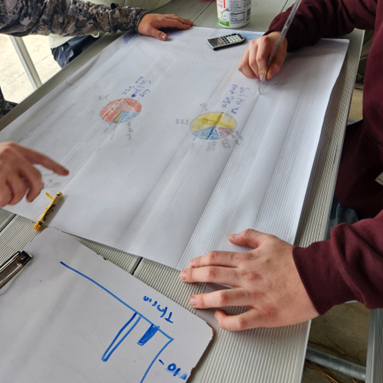 ur plot too! But, our percentages were very different,” while another commented, “I expected the soil moisture to go up [increase] as we moved down the field, but it didn’t. Are there more things we could have measured?” Moments like these, especially between peers, can lead to a deeper conceptual understanding of the math and science skills they used while also reinforcing other skills like team-work, communication, and analytical thinking.
By connecting advanced mathematical concepts to ecological observations, we’re building skills in multiple disciplines and helping ground students in their local environment. More than just numbers or proofs, this investigation helps students to visualize and connect with the data in a unique way while better understanding their local ecosystem. Blandy is excited to work with high school students in the future as we continue to offer a unique experience that blends inquiry, collaboration, and discovery in a way that textbooks and the school yard can’t provide.
Learn more about the many preK-12 education programs at Blandy!